
“AI will revolutionize the way we shop.”
You've heard this one before... actually, you've heard it four times.
In September 2025when OpenAI had launched “Buy it in ChatGPT,” letting U.S. users purchase products without leaving the chat.
In November 2025 when AI was credited with influencing $67 billion of Cyber Week spending, roughly 20% of holiday orders.
In January 2026 when Google and Shopify launched the Universal Commerce Protocol, or UCP, to handle everything from product discovery to checkout and post-purchase support.
And in March 2026 when Walmart and OpenAI’s Instant Checkout inside ChatGPT fell short, but the hype machine continued.
But the last time these words were said with a bit more reassuring tone, as if to bring the optimism around AI shopping back. The grand agentic-commerce future had run into abandoned shopping carts.
To tell you the truth, we are still waiting for AI’s shopping revolution to make noise again.
Adobe found that 36% users use generative AI chatbots, while 52% use things like “Recommended for You” sections and 52% use image search. In other words, part of the great AI shopping revolution includes technology that was recommending products long before anyone started calling it agentic commerce.
So here we are, heading into BFCM 2026 – the event which started this conversation to begin with. And more or less, you can probably guess what happens next.
Sometime in the coming weeks, another report will land saying AI will influence, assist, refer, shape, touch, or otherwise wander near a record share of holiday shopping. The number will be big with Salesforce predicting that 20% of all 2026 holiday ecommerce traffic will originate from AI chat agents and that 1 in 3 ecommerce sites will have a personal, site-specific shopper agent live by Cyber Week 2026. Everyone will repeat it. Someone will probably put “THE DEATH OF SEARCH” in a headline for good measure.
And merchants will be left with the same question:
Okay, but how much of this actually changes what I should do before Black Friday?
Well, we’d recommend to not hold your breath. See, these big numbers aren't necessarily wrong but they're measuring very different things.
But how substantial are they when you put them next to the rest of ecommerce channels? Are we watching a genuinely important new channel emerge, or hyping up a change that's currently about as disruptive as adding a new checkout lane to a supermarket with 47 already open?
That distinction matters a lot for BFCM 2026. And it matters even more when you start asking what actually needs to change before 2027.
First, let’s look at the numbers
Adobe reported that traffic from generative AI tools to retail sites grew 670% on Cyber Monday and 760% for the Nov 1-Dec 1 2025 period.
That sounds massive. And technically, it is.
But Adobe also quietly noted something else: “ ...generative AI traffic remains modest compared to other channels, such as paid search or email..."
How modest? Adobe's February 2025 report revealed that in July 2024, AI traffic was so minimal it was "too minimal to serve as baseline" for percentage calculations. Their analysts estimated it at roughly 0.1-0.2% of total traffic.
And that estimate carried the thought even to this year as well with AI traffic growing 62% year-over-year, a lot less from what was expected.
In other words, AI referrals didn’t take over shopping. They went from “barely measurable” to “still super small, but interesting.”
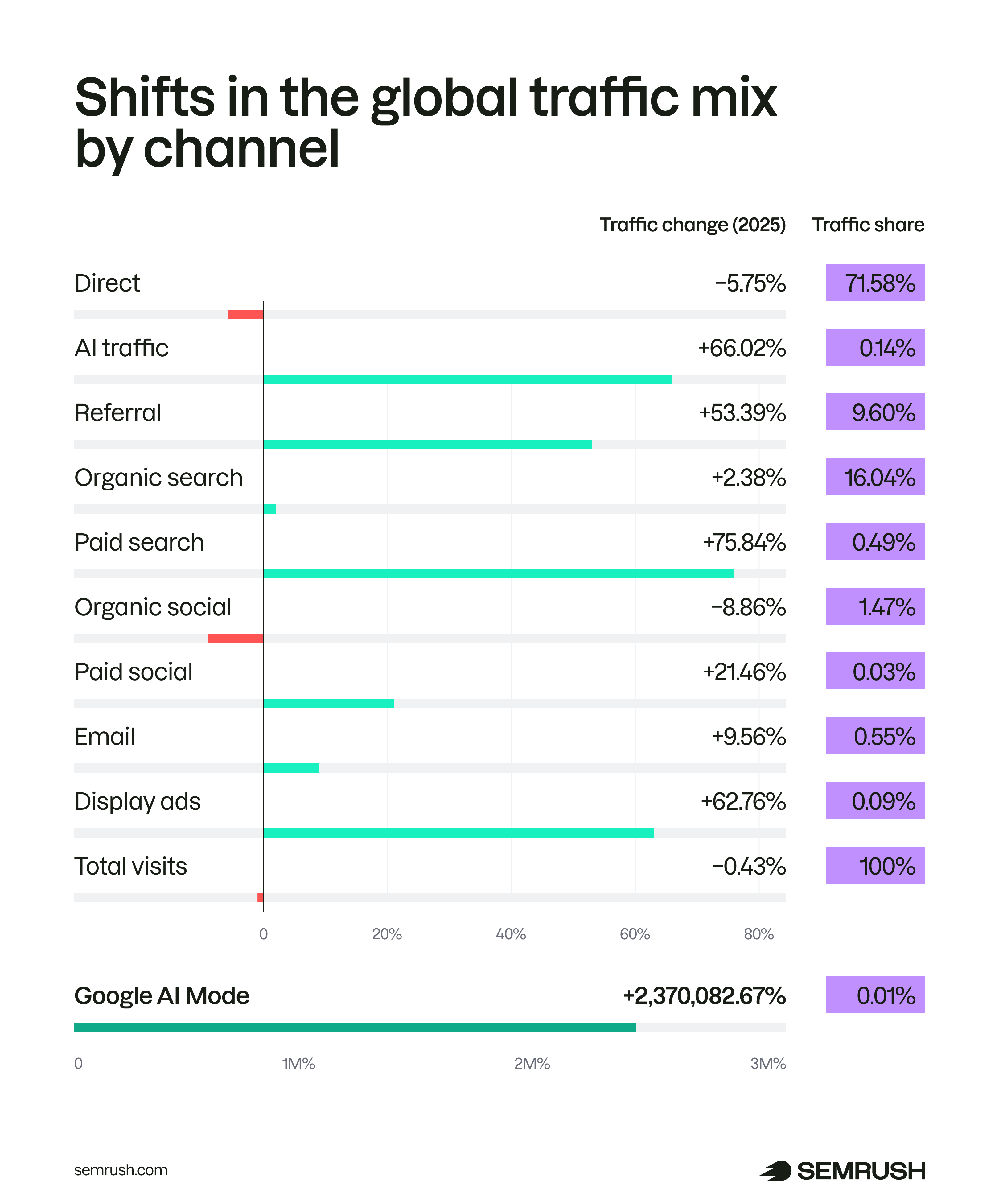
To put it into perspective that’s 0.14% of total traffic share in 2026 as compared to other sources of traffic to ecommerce websites including,
- Organic search at 16.04%
- Direct at 71.58%
- Paid search at 0.49%
- And emails at 0.55%
AI traffic, even after growing at DC Flash speed, is still contributing at a microscopic level compared to channels merchants rely on every day.
But does that mean AI shopping won’t matter? Not really. Ecommerce industry has a funny habit of going from “this probably won’t catch on” to “wait, when did everyone start doing this?” faster than anyone expects.
It just means we’re a little past the opening scene, but nowhere near the final battle. The training montage is still loading.

What does the “8x Better” claim mean?
Caila Schwartz, Director of Consumer Insights at Salesforce, stated: "Our data shows that this AI-referred traffic converts at an impressive 8x the rate of traffic coming from social media platforms, proving that AI is quickly becoming the ultimate purchase accelerator."
That sounds incredible. Too incredible actually. So, I went down the rabbit hole and looked at conversion rates across ecommerce channels. But there was a problem. Every study had its own methodology and so its own version of the truth. The numbers were all over the place.
I eventually found my anchor in a peer-reviewed study of 973 websites, which gave a pretty realistic vision of ChatGPT/LLM referral conversion rate. The study is built on regression models that report every channel relative to a baseline, adjusted for website, device, seasonality and how many sessions each figure rests on. Every published figure is a comparison: affiliate +86%, paid search +45%, organic search +13%, paid social −53%.
But one thing is sure, almost all of these channels put the LLM conversion rate way below than claimed overall, and paints a very different picture from the headline-grabbing 8x figure.
What it sounds like comparing LLM conversion rate with traditional models.
And it’s likely that the number is a bit overestimated or even underestimated for that matter. A lot of shoppers get a recommendation from ChatGPT, then Google the brand or product before buying. It could also be vice-versa. What we do know however is anyone who’s confidently and boldly asserting an 8x conversion rate hasn’t really seen the results at the scale or with a methodology that’s necessary for such a conclusion.
None of it is wrong, but it makes attribution a lot messier than the numbers suggest. The channel getting credit for the conversion isn’t always the channel that actually started the customer’s journey.
So, the number is decent, but not up there either. The question we are left now with: is AI shopping worth the effort that merchants would have to put in?
So what happens at BFCM 2026?
Three things, and none of them are a revolution. And the largest store in America won't be part of any of it. Amazon has blocked dozens of external agents, including OpenAI's, and on September 21 it shut out Meta's brand-new Muse agent twelve days after launch, telling Meta to remove Amazon from the experience entirely.
- AI will send you more traffic than last year, and it will still be small: The growth curve is decelerating hard. Adobe's own figures show AI traffic to retail sites up 693% year over year across the 2025 holidays, then 393% in Q1 2026, then 138% in May, then 62% by July. The base grows. The rate is collapsing. Expect a number well under last year's and still framed as explosive.
- Nobody is buying inside the chatbot: The in-chat checkout that was supposed to define this holiday was withdrawn in March. Forrester's March 2026 survey of answer-engine users across the US, UK and Canada found completing a purchase inside the engine was their least-adopted use case. Retailers went the other way entirely. Walmart now runs its own Sparky assistant inside ChatGPT and gets roughly 70% of its own site's conversion rate, roughly double what OpenAI's checkout managed.
- Your attribution will look worse, not better: Google Analytics only added a dedicated AI assistant channel in May 2026, and around 70% of AI-origin traffic arrives with no referrer header because mobile AI apps strip it. Those sessions land in Direct. Whatever AI number you see in your dashboard this November could be wrong, and it's wrong in the direction of understating.
What can change by 2027
Here's where we'll make some calls. Treat these as reasoned projections, not facts.
Research moves upstream, faster than the transaction does: Similarweb found US visits to AI platforms grew 28.6% between January 2025 and January 2026 while referral traffic from those services stayed broadly flat. People are comparing products inside the AI and never opening the sites being discussed. By BFCM 2027, expect a meaningful share of your shoppers to arrive with the decision already made and your dashboard showing none of it.
The 0.14% roughly doubles and stays small: The Marketing Science authors ran time-trend analysis and found gradual convergence, but their projections indicate LLM traffic will not reach parity with organic search anytime soon.
What’s actually happening now in 2026
Here’s the simplest way to understand the moment we’re in: AI is becoming a research layer, not a transaction layer.
People use ChatGPT the way they used Google to understand options, compare specs, to narrow down choices, and to ask questions they’d feel silly asking anyone out loud.
Buyer behavior shows up clearly in Adobe's June 2026 research:
- Research and comparison: 62%
- Deals and price monitoring: 56%
- Inspiration and discovery: 33%
- Fit and validation: 24%
- Order management and returns: 22%
- Customer support: 22%
And here's the number that explains why in-chat checkout failed. A survey of 1,463 US online shoppers fielded in April 2026 and published with an open dataset, 86% of shoppers who used AI for product research verified the recommendation through another source before buying. Roughly 42% said they would not trust an AI recommendation for any purchase over $25 without checking elsewhere first. Only 5% would trust AI for a purchase over $500.
The behavior is not "ask the AI and buy." It is "ask the AI, then go check."
If Google Search was the library, AI is the SparkNotes page summarizing the book and explaining every plot point. You still have to connect the dots and write the book report to submit it.

Merchants using AI vs shoppers using AI
This distinction matters more than any headline. So, here’s a table of two kinds of AI in commerce:
Merchant-deployed AI (on your site) | Consumer-facing AI (someone else's chatbot) | |
|---|---|---|
Share of shoppers using it | 52% "recommended for you", 52% image search, 33% size and fit predictions | 36% use generative AI chatbots for comparing products |
What it does | Sorts, filters and recommends inside a journey the shopper already started | Answers questions before the shopper reaches you |
Traffic it sends you | Not a traffic source. It works on traffic you already have | 0.14% of total visits |
Conversion evidence | Walmart's own Sparky assistant reached roughly 70% of Walmart.com's conversion rate | In-chat checkout converted at one-third the rate of clicking through to the retailer's site |
Who owns the customer | You do | The platform does |
Cost to adopt | Mostly configuration on tools your platform already ships | Protocol work, feed management, and no control over presentation |
Most merchants who’ve been in the game for a while have been using AI. It’s just boring, but extremely effective. You can see this in the:
- Email tools which help with personalization like Mail Chimp
- Tools that track inventory like Netstock
- Spell-check solutions like Grammarly
- Automated support like chatbots
This is where AI quietly makes money. Most don’t get catchy TechCrunch headlines, but it works.

Shoppers using AI is newer, noisier, and mostly about research. They’re using it for:
- Product comparisons
- Gift ideas
- Deal discovery
- Shortlists
That’s valuable, but not important enough at the moment.
What you should actually do right now
The smart move is boring (which is usually a good sign).
- Make sure your product data is clean and structured because that helps search, email, marketplaces, and AI equally.
- Enable low-effort AI integrations if they’re free or simple enough. There is a caveat in being easily discoverable though: Amazon’s Buy for Me might scrape your site.
- Watch your analytics. If you start seeing meaningful traffic from AI referrers, study how those users behave. Time on site, bounce rates, repeat visits.
- Assume attribution will get even worse. AI influences decisions earlier, then disappears from last-click models. Plan for fuzzier data.
- Most importantly, keep investing into channels where revenue actually comes from today.
Do these and you should be good.

Don’t put the cart before the horse
AI shopping is on its way to becoming bigger. Slowly. Unevenly. And probably not in the way the demos suggest.
Right now, AI is better at helping people decide than helping them buy. It’s upstream of checkout, not replacing it. That doesn’t make it unimportant; It just makes it early.
The mistake isn’t believing AI will matter, it’s believing it already does at scale and making your business revolve around it.
But for now, the AI shopping revolution can wait. Your fundamentals can’t.
And if you're going into this holiday season paying more for less traffic, the fastest lever you have isn't a chatbot. It's raising the value of the orders you're already winning.
That's the case for protection plans, and it's a boring one. A warranty attached at checkout is margin on a customer you already paid to acquire, on a sale you already made. And that’s where SureBright comes in. We handle the underwriting, the claims and the customer service while you keep the margin.
Want see how that looks? Contact us to get a demo.