
Incremental revenue meaning - Incremental revenue measures the extra sales created by a campaign, product launch, or pricing change - excluding revenue that would have happened anyway.
About a decade ago, a group of economists working at eBay switched off the company's paid ads on its own brand terms across Yahoo and Microsoft, while leaving them running on Google as a control. Almost all the traffic they stopped paying for simply walked back in through organic search. As one of the researchers put it, the sales impact was "indistinguishable and not significantly different than zero." eBay killed all branded search spends including Google ads on their branded keywords recovered north of $50 million a year.
So why does a decade-old experiment at eBay matter for your growth strategy today?
Because eBay had stumbled onto the ultimate digital marketing illusion. At first glance, their paid search dashboards looked impressively value positive. But in reality, they were spending tens of millions of dollars paying tolls on a road their customers were anyways walking on for free.
This is the exact trap that separates standard sales from incremental sales.
Traditional attribution models (like last-click or multi-touch) answer a surface-level question: "Which ads did a customer touch before buying?" Incremental revenue asks a far more uncomfortable but important question: "Would this sale have happened if we spent zero dollars trying to get it?"
Let's take an example with this one: let's say you are a coffee shop owner handing a 15% off coupon to someone who is already standing in line holding a loyalty card and a wallet. When that customer redeems the coupon at the register, the POS system logs it as a "promotion-driven sale." But the campaign didn't create a sale, right? It just subsidized a purchase that was already guaranteed. So, your business didn't gain a new customer but just sacrificed profit margin for a vanity metric.
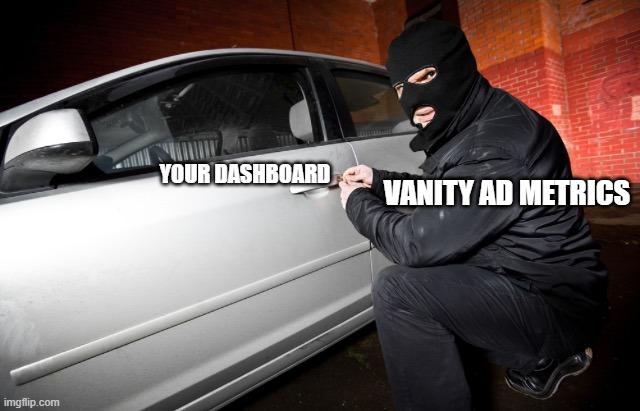
A landmark study published by the National Bureau of Economic Research (NBER) revealed that traditional ad attribution models routinely overstate ad effectiveness by multi-fold margins... because of their own incentives of course. If a tech giant with a massive team of quantitative researchers can accidentally burn $50 million a year on non-incremental clicks, what is hiding inside your own marketing spend right now?
That's what we're about to find out.
Incremental vs. total revenue
Before we fix the problem, let's separate two metrics that often get confused: total revenue vs incremental revenue. Total revenue is every dollar your business made, while incremental revenue is the extra revenue your marketing or promotions actually created
In the words of a fisherman (because why not) total revenue is the gross number of fish caught in your net, regardless of how they got there. Incremental revenue is the exact number of fish that swam into the net specifically because you dropped a specific bait in the water.
Factors | Total revenue | Incremental revenue |
|---|---|---|
What it measures | Every dollar that came in during a period | Only the dollars that would not have come in otherwise |
The question it answers | What did we sell? | What did we change? |
Where you find it | Shopify reports, your P&L, your ad platform dashboard | Nowhere. You have to estimate it or test for it |
Revenue formula | Sum of all orders | Total revenue minus baseline revenue |
What it's good for | Cash flow, inventory planning, forecasting | Deciding what to fund next quarter |
How it misleads you | Credits your campaign for demand that already existed | Depends on a baseline you can never directly observe |
4 ways to drive incremental sales (ranked by how much profit survives)
If the goal is to stop paying for customers you already have, you have to restructure your offers. Let's rank the four most common growth tactics based on how much of the revenue is genuinely incremental.
1. The pre-purchase add-on: The absolute purest form of incremental revenue happens exactly a few seconds before a customer complete checkout. This is very much like the classic McDonald’s “Would you like fries with that?”
2. The "stretch" discount: Site-wide discounts often reward purchases that were already going to happen. Don’t do that. Instead, use spending thresholds like "$20 off $100" when your AOV is $60. Customers spend more to unlock the discount, creating real incremental revenue instead of giving away margin.
3. Hard-filtered prospecting: Cold traffic is expensive, but it's the only way to measure true customer acquisition. Exclude recent buyers, site visitors, and email subscribers from prospecting campaigns. Your CAC will rise, but every conversion is far more likely to be genuinely new business.
4. The squeegee man retargeting: Did you ever wait at a red light after getting your car-washed and have a guy run up to you just to squirt soap on your windshield, wipe it off, and demand two dollars? That is what heavy bottom-of-funnel retargeting does. Sending a 15% discount to someone who abandoned their cart 10 minutes ago often just discounts a purchase that was already coming.

Now rank your channels by how much they're lying to you
Digital marketing channels operate on a fundamental conflict of interest: they grade their own homework. The platforms want to claim credit for as many sales as possible so you keep spending money with them. Here are the worst offenders:
Channel | Why it over-credits | How to test it |
|---|---|---|
Branded search ads | You are paying to appear above your own organic listing for people who typed your name | Pause them for three weeks. Watch paid plus organic branded traffic combined, not paid alone |
Retargeting to recent visitors | Serving ads to someone who still has your checkout tab open, then claiming the conversion | Exclude anyone who visited in the last 48 hours and see whether revenue actually moves |
Email and SMS to recent purchasers | Most of the value came from the reminder, not the discount. The purchase was already likely to happen. | Hold out 5% of the list and compare |
Coupon and cashback browser extensions | An extension that surfaces itself at checkout is a toll booth rather than a demand source | Switch the partner off for a month and compare net revenue and AOV together |
Post-purchase offers | Sits at the bottom of this list because the order is already banked before the offer appears | Very little to test. The counterfactual is zero by construction |
Fun fact: If you are tired of paying a premium just to defend your own brand name against competitors on Google, you can file a formal trademark complaint or serve a legal notice to the ad platforms. Courts across different geographies are increasingly cracking down on the practice of competitor keyword bidding. Even Google restricts ads that use someone else’s trademark in the ad text, that is, if the owner files a valid complaint.
How to check this without an analytics team
Unlike eBay, you don't need a group of economists to figure out what is real and what is fake. You just need to run controlled holdout tests. Here is how you do it with zero budget:
- The "poor man’s" geo-holdout test: Pick a medium-sized state or region where you get consistent daily sales - let's say, Ohio. Go into your Google and Meta ad accounts and completely exclude Ohio from all active campaigns for 14 days. Change absolutely nothing else. Watch your total backend sales in Shopify (or whatever CRM you use) for that state. If your ad dashboards were claiming they drove 40% of your Ohio sales, but turning off the ads only results in a 5% drop in total state revenue... congratulations, you just found out your ads were wildly non-incremental.
- The "Go Dark" brand test: If you are spending thousands a month bidding on your own brand name on Google, pause the campaign for one week. Monitor your total organic traffic and overall store conversion rate. If your organic search traffic spikes to perfectly fill the gap left by the paused ads, and your total sales volume doesn't dip, you just gave yourself a massive budget increase for next month.
- Native platform lift studies: Both Meta and Google offer built-in "Lift Experiments" inside their ad managers. Instead of relying on clicks, the platform will take your target audience and split them randomly. Group A sees your ads. Group B (the holdout group) is intentionally blocked from seeing your ads. After a few weeks, the platform compares the actual conversion rate of both groups. This is one of the only times the platforms give you an honest look at your true incremental impact.
So, stop buying your own customers
Test every growth tactic the same way: would the sale have happened anyway, did it borrow from future demand, shift revenue, sacrifice margin, or come back as a return? Most tactics fail at least one of those tests.
But protection plans and similar post-purchase offers behave differently here from the rest. There is no acquisition cost, no discount funding the sale, and no COGS on the back end. When an order gets returned, the attached plan simply cancels rather than dragging on your net figure the way a discounted product sale does.
The ceiling is real, and worth saying plainly. Post-purchase revenue grows with your order count, so it will not replace demand generation. What it will do is make every order you already worked hard to win carry more margin, which is the rare growth lever that does not require you to spend anything to pull it.
If you want to see what that looks like against your own order volume, SureBright can calculate your earning potential on your existing traffic and model.
So, book your demo and find out how that looks.