
Locked out of protection plans on Amazon, Walmart or eBay? Here’s what you can still offer

Overview of Contents
Selling on Amazon, Walmart, and eBay is a bit like dating three people who have very different ideas about commitment.
One wants everything done their way. Another has a few conditions before things get serious. And the third... well, you’re still trying to figure out what the relationship actually allows, isn't it?
But all three have one habit in common. They keep bringing a third wheel to your dates.
To understand this better, think of a shopper buying your stand mixer on Amazon. They click checkout, a little box slides up offering a 3-year protection plan, and they tick yes because it feels like the responsible thing to do.
So, you just sold a protection plan on your listing, but here’s where it stings: you won’t see a cent of it, and there’s a good chance you didn’t know it was on offer. So, when a shopper leaves you a one-star review for an extended warranty you never agreed to offer, confusion is the least dramatic reaction you can have.
That third-wheel is usually a third-party provider tied up with either of the marketplaces. Even sellers are noticing this when they try out their checkout, with a new seller on Amazon’s own forum even saying that they just couldn’t remember ever agreeing to warranty to be offered on their listing.
Shoppers take time to figure that arrangement. As one Redditor shared his surprise:
“So Amazon doesn’t actually sell warranties. They are offered by [other] companies ...”
Even eBay and Walmart play the same tune, bringing along third-party plans that sellers can’t opt out of. But the worst part is that buyers often assume the plan came from the seller. So, when a claim goes sideways, guess whose inbox gets the angry message?
That brings us to this article. If you’ve ever searched “amazon seller warranty” and came away with a dozen forum answers that contradict each other, this guide is for you. Don’t worry, there’s a real writer and editor who verified the facts before this piece was published.
So let’s put Amazon, Walmart and eBay rulebooks side by side. Then we’ll cover what an Amazon 3rd party seller warranty can actually say and what to do when a platform won’t let you offer one.
Let’s figure out what each relationship allows.
What Amazon, Walmart and eBay let you offer
Here's how every marketplace treats warranties:
Amazon likes everything done its way
Fun fact: Amazon keeps “Warranties, Service Plans, Contracts, and Guarantees” on its restricted products list. That means you need Amazon’s approval before you can sell a plan of your own.
Simply mentioning your warranty is a different story, but Amazon is picky about where you mention it. One seller was told that “warranty” was no longer permitted in the product description. After moving it to another field, they watched the error flags follow the word around like a jealous ex.
So the word itself isn’t banned. It just isn’t welcome in your bullets or description. Think of it like a dinner party where the host has assigned seats: your Amazon seller warranty description has a seat of its own, in the warranty field of your category’s listing template. Some listings also let brand owners attach a warranty PDF that shoppers can open from the product page.
Walmart will give you many conditions before things get serious
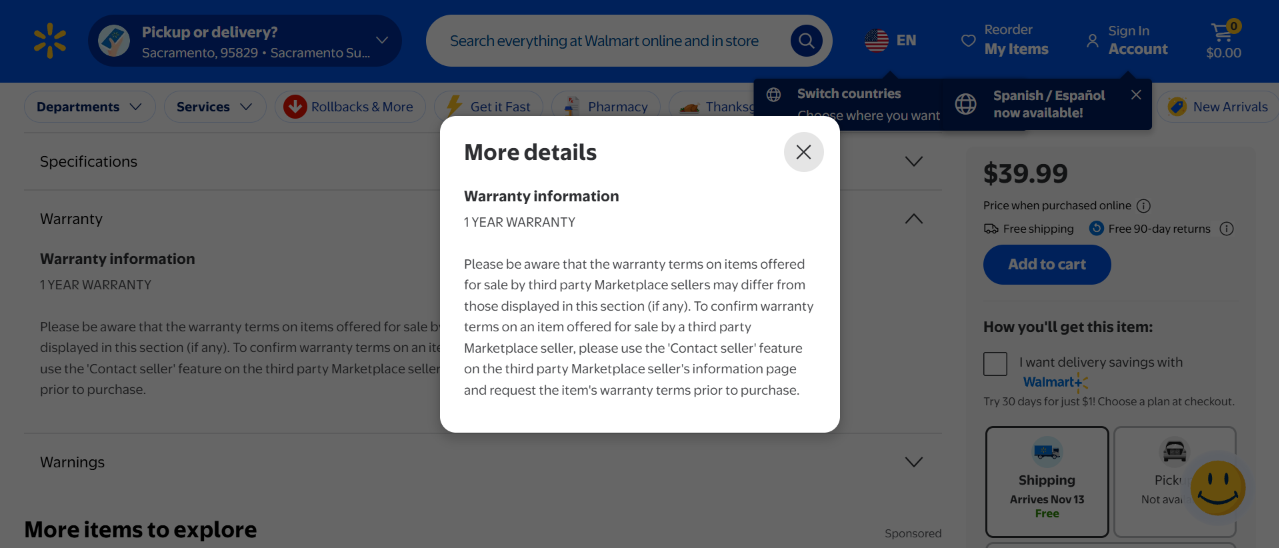
Walmart sells its own protection plans. On third-party listings, it adds a polite disclaimer telling shoppers that warranty terms from Marketplace sellers may differ and that they should use “Contact seller” to confirm them before buying.
Its rules on reaching customers are the strictest of the three. Walmart’s Seller Code of Conduct bans promotional materials in order fulfilment, along with URLs or third-party website details anywhere customers can see them. So when a buyer’s laptop dies, things usually go the way this Redditor described:
“they’re going to tell you to contact the walmart protection plans, IF YOU BOUGHT THAT. if you didnt your only other option is to check around on your box or online & see if the company of the laptop automatically comes with a 1, 2, or 5 year warranty.”
So, after a year or so, your customer will either have a protection plan they purchased through Walmart or a dead laptop and a whole lot of Googling ahead of them.
eBay is still defining the relationship
eBay restricts you from offering your own warranty with a few conditions. Under its warranty policy, any item over $15 that comes with a warranty or service contract must include the full text in the listing, or a statement explaining how buyers can get a free copy.
Now, before you think that that $15 line is eBay being fussy, it actually makes sense legally. It's a federal rule to let the buyers be able to read written warranty terms before they buy a product over $15.
What eBay won’t tolerate is using a sale to pull buyers away. Its off-eBay policy bans using contact details from an eBay transaction to sell outside eBay. Breaking it can cost you more than a warning: eBay has said sellers who try may be charged a final value fee even if the item never sells. That’s paying for dinner after being stood up.
Meanwhile, eBay adds third-party plans to listings at its discretion, and sellers can’t opt out, as mentioned by this eBay forum member:
"it's added by ebay, nothing you can do about it, they decide. As mentioned your not charged or have anything to do with that part the sale. But someone trying to make a claim may find it a nightmare to collect from it."
Here’s how the three compare:
Factors | Amazon | Walmart | eBay |
|---|---|---|---|
Sells its own plan on your listing? | Yes | Yes | Yes |
Can you sell your own plan? | Only with approval | Not through the listing | Yes, but highly regulated |
Warranty terms in the listing | Warranty fields and PDF, not bullets | Shoppers are told to contact you | Full text required for product over $15 |
What's off-limit? | Warranty card's fine, QR codes a gray area | URLs or promo materials | Off-eBay selling or contact grabs |
Is the box in which your product ships the only billboard you still own?
Well, sort of.
On Amazon, there’s no standalone insert policy. The review rules simply extend to whatever goes in the box. A printed warranty card is widely treated as customer service content. A QR code pointing to your warranty registration page sits in a gray zone that Amazon has never addressed. The version most guides call safe is a QR code that links to a registration or how-to page with no email capture. Plus, if you use FBA, the packaging requirements say Amazon will not accept marketing materials, including pre-priced labels, pamphlets, price tags or other non-Amazon labels.
On Walmart, a QR code is a big no-no, and the Code of Conduct already makes that clear. eBay only rings the alarm when a code leads to a sign-up form because it looks like the seller is collecting buyer details to sell off-platform.
The simple rule for all three is that the box can inform, but it shouldn’t sell.
Does it even matter whose plan your customers buy, anyway?
I'll let the research answer that.
A study of eBay sales found that a warranty earns sellers a price premium, and the premium is biggest for sellers who haven’t built a long reputation yet.
A second eBay study looked at sellers with eBay’s “Top Rated” badge, who normally get a bit more money for the same item because buyers trust them more. When eBay rolled out its own buyer protection, that badge was worth less. Once eBay promised to cover buyers itself, shoppers had less reason to pay extra for a trusted seller. Another eBay study found that when the platform adds its own buyer protection.
Put those together, and the picture is uncomfortable for two reasons:
- Protection is a trust signal that works hardest for sellers still earning their stripes. When the marketplace sells that signal on your listing, it borrows the trust you’d otherwise build.
- The plan revenue goes to the platform and its provider, while the support emails stay with you.
That’s the deal every marketplace warranty offers. Whether it’s a fair one depends on whether you have anywhere else to offer protection under your own name.
Locked out? Here's how to protect your buyers
"Just a note of caution. I found out the hard way that a warranty on Ebay isn't worth a damn, even if the listing mentions it more than 20 times (literally)."
As this Redditor found out, a warranty is only as good as whoever stands behind it. A promise in a listing with nobody to call is just decoration. Coverage backed by a real provider, with a real claims process, is something buyers can actually use, and it shows up in your numbers. Sennheiser, for instance, pushed warranty attach rates past 29% while cutting returns by 26%.
So the goal is to offer protection that holds up when it’s needed. Here’s how to do that on each marketplace:
- Put the full terms where the platform allows them - On eBay, that’s the listing description, which the policy requires anyway. On Amazon, use the warranty fields or a warranty PDF if your listing supports one.
- Ship a printed warranty booklet - Include the full terms and tell buyers to make claims through the platform’s messaging. Leave out URLs and anything that reads like an ad. This is the one insert that holds up on all three marketplaces.
- Use a QR code, but carefully - Point it at a page that shows your terms or registers the product, with no email capture and no shopping links. On Walmart, skip it entirely.
- Join the programs the marketplace already backs - eBay Refurbished items come with a one- or two-year warranty, so protection becomes part of your badge rather than a competitor’s add-on.
- Bundle coverage through a licensed provider - A protection plan is a regulated contract, so a licensed company has to stand behind it. On Amazon, you’ll also need approval for the restricted category, so expect some paperwork before your first sale.
- Build the protection relationship on your own store - The marketplace owns the checkout on its site, but it can’t touch yours.
Remember, the customer comes back to whoever fixes it
Marketplaces will keep bringing their third-wheels, and most retailers can’t change that. What you can change is where your buyers meet your protection.
On your own store, the plan carries your name, you choose the coverage, and you share in the revenue instead of watching it leave with a third wheel. SureBright helps merchants offer branded protection plans at checkout and handles the claims, so when the motor gives out 14 months later, the fix feels like it came from you.
Want to see how much you can earn with warranties? Calculate your ROI

Author
Khizar Mohd
M Khizar is a writer who enjoys making complicated things feel simple. He writes about warranties, e-commerce, and the small details people usually overlook until they matter. His work focuses on clarity and helping readers make smarter decisions without overthinking it. Outside of work, he enjoys reading, writing personal blogs, and binge eating with friends.